


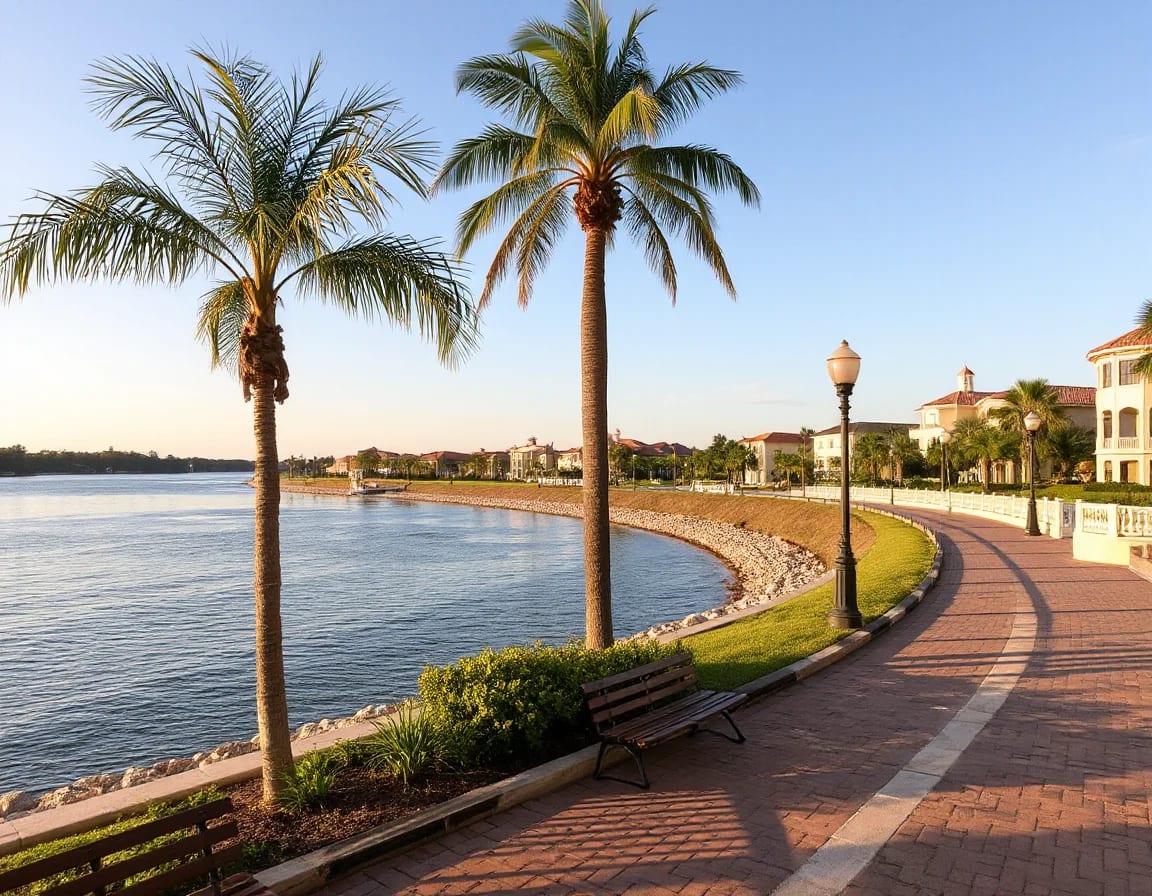

A client called me last spring with a screenshot pulled from a real estate trade site. It quoted Positano, the beachfront enclave inside Miromar Lakes, starting at eight million dollars. She wanted to know if that was still the number. It wasn't. By the time she asked, the same neighborhood was listed starting at $6.7 million, with one more home in the total count than the article described.
That gap is the whole story. New construction at Miromar Lakes gets covered the way a product launch gets covered: one press cycle, one starting price, one delivery promise, and then the coverage moves on while the project keeps changing underneath it. If you're comparing new construction to resale inside the gate, the number you found in a search result six months ago is closer to a fossil than a fact. Here's what actually moved, and what it means for how you shop.
Three neighborhoods, one launch, three different stories now
Miromar Lakes opened sales on three new-construction enclaves in the fall of 2024: Positano on the beach, Messina along the golf course, and Nerano, a coach home neighborhood built by Front Door Communities. Each had a headline number at launch.
• Neighborhood | Launch pricing (October 2024) | Where the number stands now
• Positano | Starting at $8 million, 10 homes, 5 homesites available | Starting at $6.7 million, 11 homes total, still 5 available as of the developer's most recent update
• Messina | Starting at $2.9 million, 12 golf-course villas | No updated starting price has surfaced since launch
• Nerano | Starting at $1.1 million, 12 residences promised for fall 2024 delivery | Still selling in 2026, with completion dates that vary depending on which listing you read
Positano is the one worth sitting with. The launch price was $8 million for 10 homes. The current price is $6.7 million, and the total grew to 11 homes. A lower price with more inventory sounds like a straightforward discount, but it's just as likely to be a builder recalibrating for a wider buyer pool once the first wave of ultra-high-end buyers had already picked their lots. Either way, if you were pricing your own comparable purchase off that original $8 million figure, you'd be negotiating against a number that hasn't been true in over a year.
The delivery date that keeps rescheduling itself
Nerano is the more interesting case, because it isn't the price that moved. It's the calendar.
When Nerano launched in October 2024, the announcement promised 12 residences delivered that fall. Fall 2024 has come and gone, and by this September so have several of the interim dates attached to the project since. One listing source shows three homes that were due for occupancy by March 2026, with four more scheduled for this November. A separate, concurrent listing for what should be the same 40-unit release describes a different sequence entirely: two homes due by May 2026, three more by August, and four more by December. March, May, and August have already come and gone as of this writing, which means both schedules are already running on borrowed time for at least part of their promised count.
Those are not small rounding differences. They're two different construction schedules attached to the same building count, showing up at the same time, for the same neighborhood. Neither listing is necessarily wrong. Phased construction means different buildings in the same enclave hit certificate of occupancy at different points, and whoever wrote each listing was likely describing a specific building or phase rather than the whole project. But if you're a buyer trying to time a move around a delivery date, you cannot take any single listing's schedule as the schedule. You have to ask which building, which phase, and how current the information is.
This is the mechanism that matters more than any single number. New construction pricing and timelines are true at the moment they're published and start decaying the day after. A builder's press release is a snapshot of demand and construction status on one specific date. It is not a contract term, and it is not something you can hold a builder to eighteen months later.
Why this happens, and why it isn't a red flag
None of this means something is wrong at Miromar Lakes. Phased release is standard practice for a builder managing 40 units across 10 buildings, or 11 estate homes on a finite stretch of beachfront. Early pricing often reflects the first phase of construction costs and the smallest, most motivated buyer pool. As a project sells through and the builder has a clearer read on demand, later-phase pricing gets adjusted, sometimes up, sometimes down, based on what actually moved and what didn't. Delivery dates shift for the ordinary reasons construction schedules shift anywhere in Southwest Florida: permitting timelines, material lead times, and the sequencing of which building gets finished first.
The mistake isn't buying new construction. The mistake is walking into a conversation with a builder's sales office holding a number you found in an old article, instead of asking for the dated, current construction schedule for the specific unit you're considering. A live schedule from the sales office this month is worth more than any press coverage from 2024, no matter how polished the coverage was.
What this means if you're weighing new construction against resale
If predictability matters more to you than customization, an established Miromar Lakes neighborhood like San Lorenzo, known for custom waterfront estates with private boat docks already in place, removes the delivery-date variable entirely. You know what you're getting and when you're getting it, because it already exists.
If you want the ability to choose your own layout, whether that's a Lucca ground-floor residence or a Savona top-floor unit with a private elevator in Nerano, or a golf-course villa in Messina, which launched at $2.9 million, new construction still makes sense. You're just buying into a schedule that will move at least once between your deposit and your closing, and you should price that uncertainty into your decision the same way you'd price in any other unknown.
Either path works inside a community built around a 700-acre lake, three miles of private beach, and an Arthur Hills golf course. The choice isn't between a good option and a bad one. It's between a fixed asset you can inspect this week and a moving target you'll need to check on every few months until the certificate of occupancy is actually issued.
A few questions worth asking before you write an offer
Is Positano sold out? Not as of the most recent information from the developer, which still shows homesites available at the current $6.7 million starting price. Ask for a same-week update before assuming availability, since that can change quickly on a small release.
Why do two listings for the same Nerano building show different completion dates? Most likely because they're describing different phases or buildings within the same 10-building release, updated at different points in the sales cycle. Ask your agent to confirm which specific unit and phase any quoted date applies to, and get it in writing from the builder rather than relying on a listing description.
Should I expect the price to keep changing? Possibly. Positano's per-home starting price moved down as the unit count moved up between late 2024 and mid-2025. That is not a promise of future direction, just evidence that these are not fixed numbers once a project starts selling. Treat any published price as a starting point for a conversation, not a locked figure.
If you are weighing a custom build against a move-in-ready home inside Miromar Lakes, or trying to make sense of a listing that does not match what you read somewhere else, that is exactly the kind of question worth working through with someone who tracks this community closely. Timothy Steeves can walk you through what is actually available right now, not what a headline said eighteen months ago. Let's Connect.
This article is general information, not legal, tax or financial advice. Consult a qualified professional about your situation.